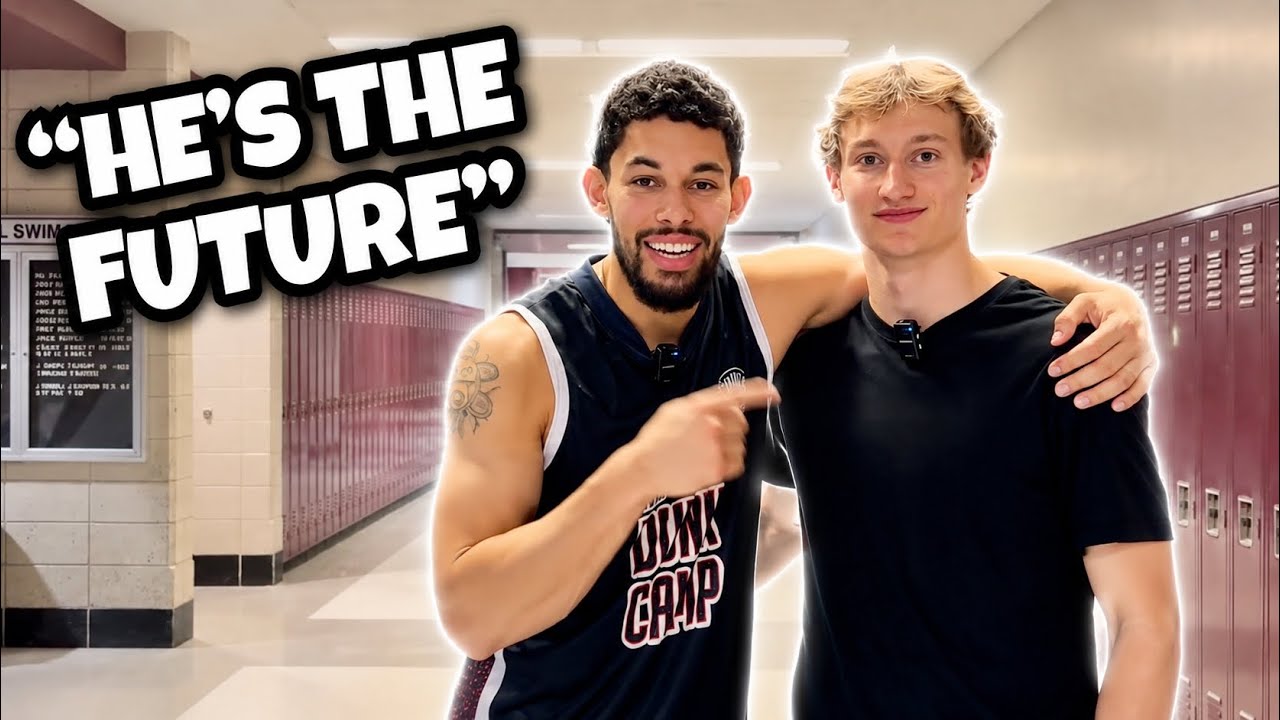
Elite dunkers compliment younger dunkers constantly. It happens at every session, every camp, every contest warmup. Almost none of it survives the week. The nice thing gets said, the people go home, and the only record is a memory that the person being complimented can never prove.
This one survived, because there was a camera on it.
“He’s the future, man. He is the future.”
Isaiah Rivera
That’s Isaiah Rivera at The Dunk Camp 2026 in Salt Lake City, talking about Piotr Zawiślak, who is 18 and from Poland and has named Isaiah as his favorite dunker since before anyone in the sport knew who Piotr was. The subject of this article is not the compliment. It’s what happens to a compliment when you record it, publish it, and give it a URL.
A Co-Sign With a Receipt Attached
What makes this clip usable is that Isaiah didn’t stop at the nice sentence. He gave a specific, verifiable reason.
“I missed 360 Underboth a bunch of times. You hit it second try at a session.”
Isaiah Rivera
An elite pro publicly stating that he repeatedly missed a dunk that an 18-year-old landed on his second attempt, at the same session, is a very different asset than “he’s really good.” It’s checkable. It has a place, a dunk name, and an attempt count. Anyone can watch the tape and decide for themselves whether they believe it.
“I can’t fathom even doing the stuff you’re doing at 18 years old.”
Isaiah Rivera
He added that his own vertical at that age was nowhere near 44 or 45 inches, that his first 360 Eastbay barely went down, and that watching Piotr made him feel old. Then he widened it out past the two of them: “it also shows me how much the dunk game’s evolving.”
The Part Nobody Could Have Scripted
Two days before that interview, Dennis Yu and I ran a classroom session at the same camp for 76 dunkers. We audited every one of them beforehand and posted the results publicly at the Dunk Camp 2026 audit leaderboard. The core message was that talent alone doesn’t get you found, and that learning to market yourself is a real skill worth training. The full session is documented at the repurposing system taught to 76 athletes.
Then Isaiah, who was not in that room and had no idea what we’d taught, answered a question about how to reach the top of pro dunking.
“The pro dunking game, you gotta get good at social media. You gotta get good at marketing yourself. That’s a skill in and of itself, so master that.”
Isaiah Rivera
“all of us, myself, Jake Clark, Jordan Kilganon, 1FootGod, we all mastered the social media game as well.”
Isaiah Rivera
We couldn’t have manufactured that. When we say it, we’re the people selling personal brand websites to dunkers, and a reasonable person should discount it. When Isaiah Rivera says it unprompted, and lists three other dunkers at the top of the sport who did the same, that’s a different kind of evidence. He’s not affiliated with us, he’s not being paid to agree, and he arrived at it from inside the sport rather than from marketing.
Moments Evaporate, Documents Compound
Here’s the practical difference. If that exchange had happened with no camera, Piotr would own a great story he could tell in interviews, and every listener would have to take his word for it. Instead it’s a two-minute video with a timestamp, a transcript, quotable lines, and a permanent address on the internet.
A brand looking at Piotr can watch it. A contest organizer deciding on an invite can watch it. A journalist writing about the next generation of dunkers can quote it and cite it. Six years from now, when Piotr is competing at whatever the sport becomes, that clip is still there and still says the same thing.
That’s the gap Dunker Spotlight exists to close. Dunkers produce some of the best video content of any sport on earth and stay almost completely invisible to Google, to AI assistants, and to the people who write sponsorship checks. The dunking isn’t the problem. The record-keeping is.
This Article Is the Thing It’s Describing
Worth being direct about the loop here, because pretending otherwise would be silly. Dennis closed the camp session by offering to interview any camper who wanted it, make a video, and put it on our sites. Piotr took the offer. The interview at the top of this page is that offer being kept, and this article is the second half of it.
One two-minute conversation became five articles across five sites, each one written from a different angle and each one linking to the others. Piotr’s own first-person account is at Isaiah Rivera called me the future. The dunk-community breakdown of all three pieces of advice is at Isaiah Rivera’s three rules for young dunkers. The version for athletes outside dunking is at the endorsement you cannot buy. The search and AI mechanics are at why an expert co-sign is an entity signal.
That’s the same pattern we demonstrated on stage using Cam Hazzard’s personal brand site, which was built in about 20 minutes from a single 20-minute interview and now ranks nearly his full first three pages of Google on his own name. Same system, different dunker, done in public so you can copy it.
What to Actually Do With This
If you’re a dunker, the takeaway isn’t “go get famous people to say nice things about you.” It’s simpler than that. The nice things are probably already being said to you at sessions and camps. You’re just not capturing them.
Turn the camera on before you ask the question. Ask for a specific, not a general compliment, because “he’s good” is worthless and “I missed that dunk a bunch of times and he hit it on his second try” is a credential. Then put it somewhere permanent that you control, with the quote written out in text so a search engine can read it.
Isaiah’s last piece of advice to Piotr was to enjoy the moments, because nobody dunks forever. He’s right. Document them while you’re enjoying them, and the moments outlast the career.