Cam Hazzard built a complete personal brand site in about 20 minutes over lunch, starting from a single 20-minute interview video. The next day he spoke at a conference, and he now ranks for nearly his entire first three pages of Google on his own name. That is what a structured digital presence looks like when the steps get executed in the right order.
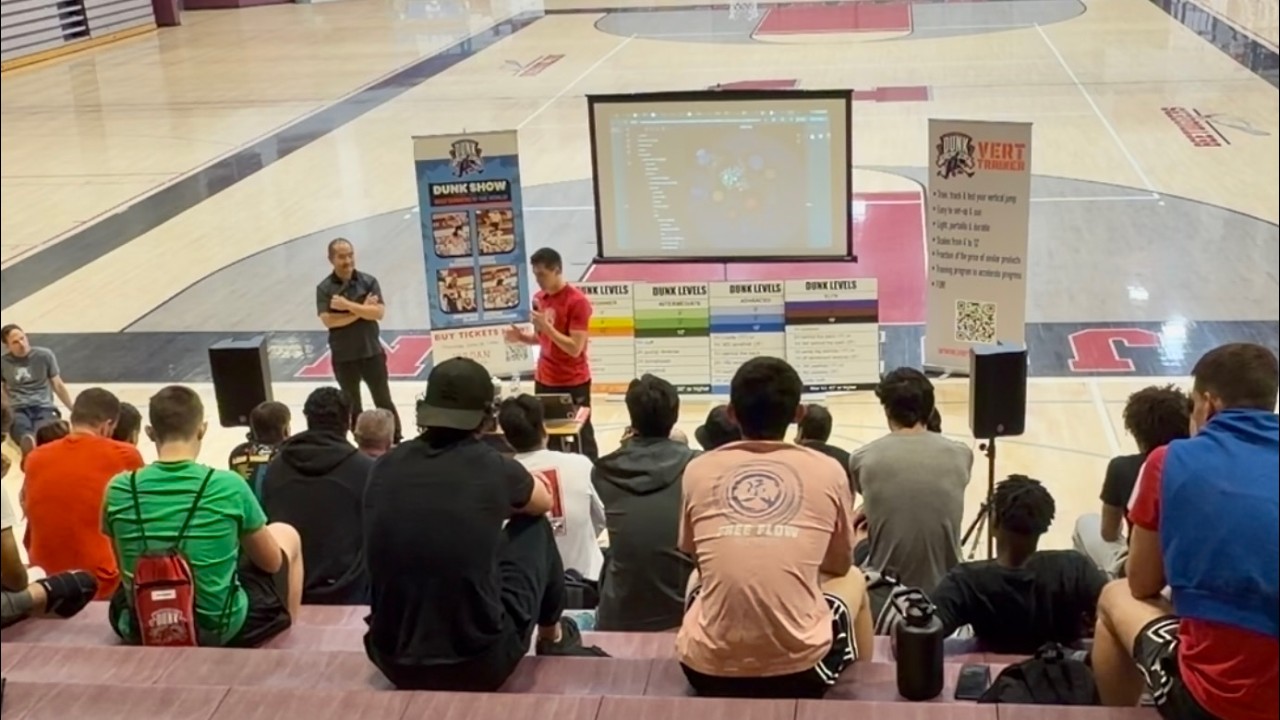
At The Dunk Camp 2026 in Salt Lake City, Dylan Haugen and Dennis Yu ran a 30-minute session for 76 dunkers on exactly this process: how to go from invisible online to found, followed, and sponsored. They audited every camper before the session started. The ranked leaderboard is public at dunkerspotlight.com/dunkcamp26, with a downloadable PDF for each athlete. The session was not a pep talk. It was a playbook with a starting point built in.
This article walks through that playbook step by step. Each step maps to something a dunker can act on, starting today, with the content they already have.
Step 1: Audit Where You Stand
The first move is honest accounting. Before the Dunk Camp session started, every camper had already been audited. Dylan pulled up profiles, searched names in Google, tested what came back from ChatGPT. The results were the starting material for the whole room.
Before the session, Dylan said on stage:
“if you Google my name, it was just randomness. If you asked ChatGPT who I was, again, it was just confusion.”Dylan Haugen
That was his own description of where he started before he built the infrastructure that earned him a Google Knowledge Panel at 17. The audit is not a judgment. It is a baseline. Dylan was explicit about that on stage too:
“you can just treat this as a starting point. It’s not, obviously not perfect.”Dylan Haugen
Pull up your own name in Google. Search for yourself in ChatGPT. Check whether a Knowledge Panel appears. If none of those return a clean, accurate result about who you are and what you do as a dunker, that gap is what the rest of this playbook closes. For a more personal look at what the session meant from the inside, read Dylan’s reflection on returning to camp.
Step 2: Inventory the Real Content You Already Have
Most dunkers have more content than they realize. Dylan has 200+ long-form YouTube videos and 80 podcast episodes. Cam had an interview video from a lunch conversation. The raw material already exists for most athletes who have been competing and posting for a few years.
The goal at this stage is a full count: every video, every podcast appearance, every press mention, every competition result. Write it down. This inventory becomes the source material for everything that comes next. Dylan described the method on stage:
“our goal is to repurpose and take things that already exist, your real stories, and turn them into articles that live publicly.”Dylan Haugen
The content already exists. The step that most athletes skip is taking that content and turning it into structured, indexed material that search engines and AI assistants can actually find and understand. For the full community and session recap, see our Dunk Camp branding session on Dunk Talk.
Step 3: Build Entity Authority So Google and AI Know Who You Are
This is the step most dunkers have never heard of, and it is where the gap in the Dunk Camp leaderboard comes from. Entity authority means that Google has high confidence in who you are and what you do. Dennis Yu, who spent 30 years in digital marketing and built the analytics at Yahoo in the late 1990s, explained the framework on stage:
“A lot of people think that being verified on Google, which is necessary to claim your Knowledge Panel, is like a vanity thing, like being verified on TikTok or verified on YouTube, but it’s actually deeper. It’s saying how well does Google understand who you are and what you do.”Dennis Yu
Dennis uses a confidence score to measure this. Anything above 400 is celebrity tier. Dylan’s is above 3,000. Jordan’s is roughly 1,700. Shaq’s is around 40,000. The score measures how thoroughly Google has connected the structured signals across the web: a personal brand site that owns your name, a Wikidata entity, Person schema, and consistent mentions on credible sites.
Dennis made a point on stage that applies directly to every dunker building a presence in 2026:
“that’s also the key to showing up in ChatGPT or Claude, because that same structure is the same thing that all these LLMs look at.”Dennis Yu
The three inputs that build entity authority are: a personal brand site at your own domain (your name.com), a Wikidata entity with accurate facts and connections, and Person schema on your site that explicitly defines who you are. Brooke Lance, who ranked #2 on the Dunk Camp leaderboard, has a Wikidata entity and a personal brand site already in place. Cam Hazzard’s full build is documented at camhazzard.com. For the technical method behind building this kind of entity presence, read how we built Cam Hazzard’s personal brand with AI on BlitzMetrics.
Step 4: Repurpose One Video Into Articles Across a Network
Once the structural foundation is in place, the next step is content distribution. One video becomes five articles on five different sites. Each article lives at a different domain, carries a different angle, and links back to the others. That network of pages, all pointing to the same person, is what builds search presence at scale.
Dennis described the underlying logic on stage using Steph Curry as the example:
“Steph Curry would have a crazy half-court shot, that didn’t make any money, even though it might get a million likes on it. What we would do is we would boost that. We would turn it into articles.”Dennis Yu
The same principle applies to a dunk clip, a competition performance, or a behind-the-scenes training video. The clip captures the moment. The article explains the story, names the context, and gives search engines something to index. Dennis and the team have run this approach for Nike, Adidas, the Golden State Warriors, and Red Bull. The one-video repurposing system is documented in full on BlitzMetrics.
AI agents handle the execution. Dylan walked the room through how the system works and made it approachable:
“you just talk to the thing like it’s a team member or a coworker and just direct it.”Dylan Haugen
The agents do not replace the athlete’s story. They process and distribute it. Dylan and Dennis gave 10 pre-built agents to campers at the end of the session. Dennis framed the economics simply: a personal AI agent that works for one athlete, costs about $20 a month, and does the distribution work that would otherwise require a media team. For the broader playbook context connecting this to local service businesses and brand builders outside of dunking, read the same playbook for local service businesses.
Step 5: Get Found, Followed, and Sponsored
The first four steps are infrastructure. Step 5 is where the infrastructure pays off. When Google accurately understands who you are, when ChatGPT returns a correct answer about your dunking, when your name owns its first three pages of search results, you become findable. Sponsors, shoe brands, coaching inquiries, paid contest invitations, and show bookings all follow discoverability.
The DunkMan League, Shaq’s pro dunk league with a breakout 2026 season, features athletes including Dylan and Cam Hazzard. Cam built a positive-mentions agent and demoed it at the Detroit AI Summit. He ranks for nearly his entire first three pages of Google on his own name. That kind of presence creates opportunities that do not come from social follower counts alone.
The full knowledge-gap analysis behind why most athletes stay invisible even with great clips is covered in Dennis’s own write-up at Dennis Yu on the creator knowledge gap.
The path from invisible to sponsored runs through the same five steps for every dunker regardless of follower count: audit, inventory, structure for entity authority, repurpose, and distribute. The leaderboard at dunkerspotlight.com/dunkcamp26 shows where the 76 Dunk Camp athletes stood at the start of this process. Every one of them has a PDF audit. That PDF is a starting point, not a verdict. The dunkers who act on it are the ones who show up correctly in search and in AI, attract the right attention, and build the kind of presence that converts into real opportunities.
Originally published .